Cracking Crick
- Mishkat Bhattacharya
- 2 days ago
- 3 min read

This post is a review of the book Crick: A Mind in Motion by Matthew Cobb.
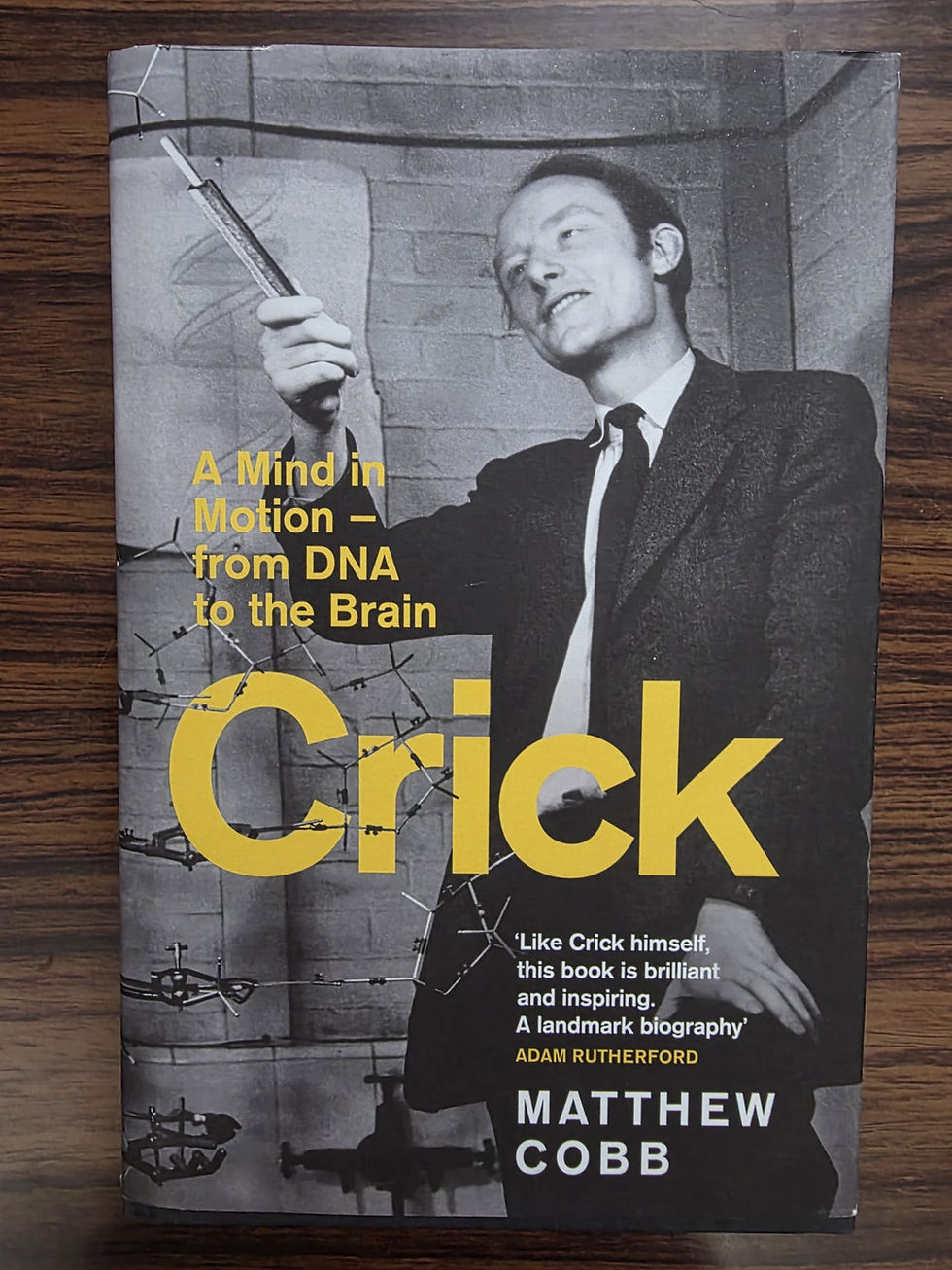
I found three motivations, not in order of importance, for reading and reviewing this book.
First, after covering a biography of Watson, I thought it would be appropriate to read and review a bio of Crick.
Second, this biography advertised itself as an intellectual biography, one that follows essentially the mind of Crick. It purports to focus on Crick the scientist, revealing to us the motivations and methods of this super scientist.
This is largely true and the author has done a skillful job of interspersing substantial passages about the science (I understood maybe 40% in any detail as my biology is pretty bad; but it is easy to get the general gist) with discussions of relevant professional and personal events are included. The two main - but very broad as well as detailed - themes in his work were the search for the molecular basis of life and the material basis of consciousness (of much interest in the academia, industry and media now).
Crick's parents were well-educated and encouraged his explorations (including some violent chemical experiments). An encyclopedia sparked his interest in science. He was not a prodigy, and only about averagely bright in high school. Crick received his undergraduate degree from University College, London and PhD from Cambridge. The first half of his career brought him into contact with Max Perutz (Nobelist; a mentor), Bragg (Nobelist; a promoter after some false steps), the mathematical (and narratophilic character of) Georg Kreisel, Watson (famously), Franklin (see below), Wilkins (co-recipient of the Nobel), Sydney Brenner (Nobel), etc.. His later work in neuroscience brought him into contact with (the work of) Hinton (recent Nobel), John Searle, V. S. Ramachandran, Roger Penrose (Nobel), and Gerald Edelmann (Nobel).
Third, the book claims in its introduction to debunk the popular conception that Crick and Watson 'stole' Rosalind Franklin's results by presenting new information. The book tries to do this by citing proof
i) That Crick and Watson already were close to converging on the helix as the right solution before they talked to Franklin (and Wilkins).
ii) That she presented the information at a talk where Watson was present, and their main fault was Wilkins showed them Franklyn's data later without her permission.
iii) They clearly acknowledged her role in the first few papers they published.
iv) That when Jacques Monod informed Crick that he was going to nominate him, Watson and Wilkins for the Nobel prize, Crick sent a response clearly highlighting Franklin's contributions.
v) That Franklin never complained about being left out of the Prize. In fact, she became a close colleague and friend of Crick's, and actually convalesced after some of her cancer surgeries, at his home.
Nonetheless, not being a biologist or chemist, and even less a historian, I will refrain from taking any sides, and the readers can judge the issue for themselves.
Summary
The book is substantial even if one denies that it settles the controversy. The mechanics of frontline research in biology in the previous century is sketched in realistic detail. All kinds of colorful characters, exotic conference venues and scientific politics feature in the writing. The research behind the book seems considerable and thorough in keeping with the fact that the author is a zoologist. Crick's persona emerges quite substantially, with some interesting interludes to beat poetry (the famous City Lights Bookstore in San Francisco plays a prominent role) and art.
Quite readable, educational and entertaining.